Discovering Mastery in the Art of Connective Tissue Massage
By John Latz — Institute of Structural Integration
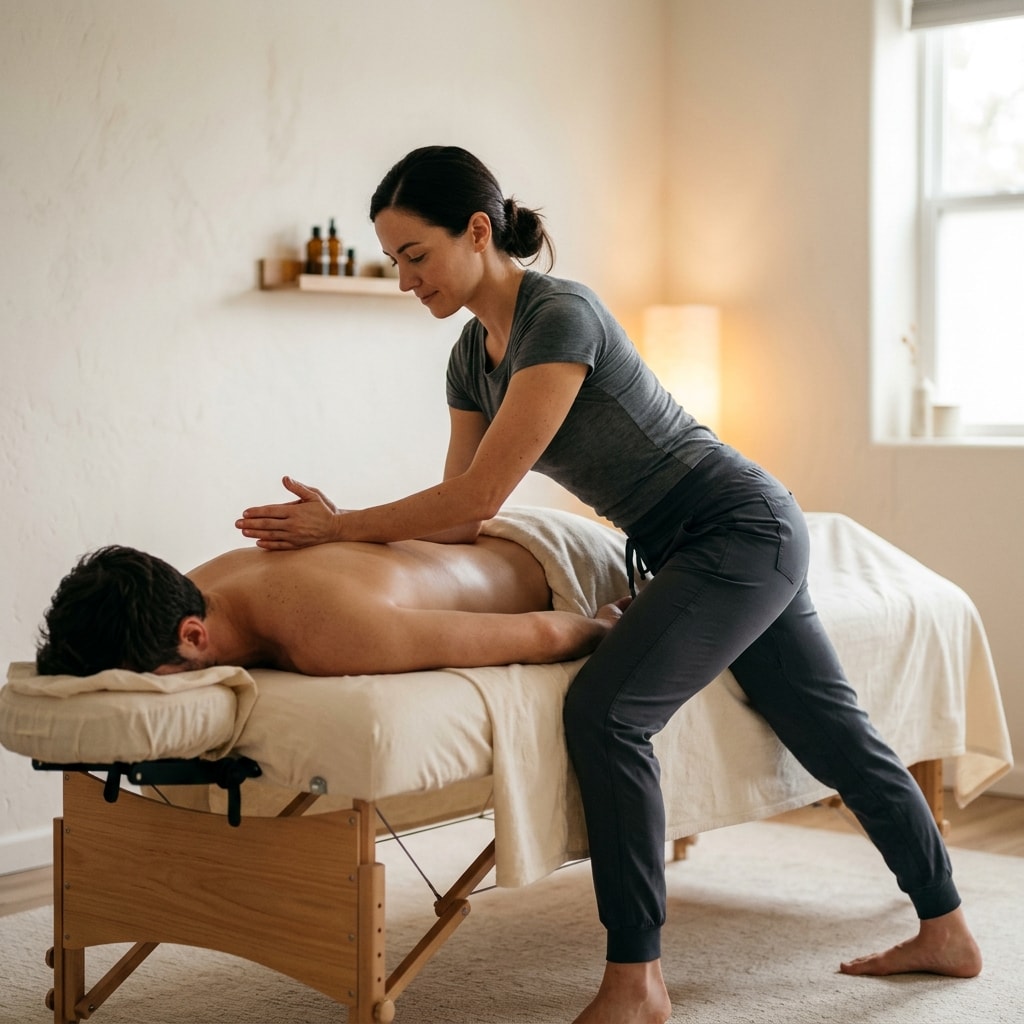
Shifting paradigms is hard work for most people. This is especially true when our ego is involved and our paradigm is reinforced by cultural norms. Imagine a scenario that would set us up for a major shifting of our ordinary paradigms.
"I, an ordinary massage therapist, working in an ordinary massage office, in an ordinary town with ordinary clients, leading an ordinary life, suddenly die of an ordinary, albeit unexpected, heart attack.
I arrive at the pearly gates, am greeted by Saint Peter. He asks:
'How many massages did you give in your lifetime?'
'I don't know. Several thousand, probably.'
'How many massages did you give when you felt fully present to your client?'
'I don't know. Maybe 25%.'
'How many of those massages were given from your core being?'
'I don't know. What's my core being?'
'I am so sorry. You must go back to earth and study with John Latz. You cannot die until you have fully lived in your core being, and given others the chance to live in their cores also.'"
— Contributed by L.N. LMT, student of CTM
Dr. Ida P Rolf, like Saint Peter, held the keys to a certain spiritual truth.
I encountered my own misinformed paradigm when I initially experienced Dr. Ida P. Rolf's Structural Integration work. Before that, I had had only one perspective about my body, the perspective of a competitive swimmer. My only goal was to develop good-looking, "hard" musculature through rigorous training.
Ida Rolf's method of Structural Integration changed all of that. I discovered my "intrinsic" musculature, my own "core," and it blew away my culturally imbedded notions about structure, strength and movement. It shifted my paradigm.
I started competitive swimming at a young age and by the time I entered college I was competing on an athletic scholarship and training three hours a day, plus lifting weights. My body was, to use a colloquial expression, TIGHT.
The many years of conditioning had left me overdeveloped in my extrinsic musculature. I believed this condition was the ideal one for anyone's body, until I studied massage therapy in 1980. At that point, I realized how much muscular effort I used in everything I did, especially swimming and massage. Although I enjoyed giving massage, it wore me out. I did not know how to relax—how to soften my muscles, how to un-tense my muscles while I worked and did not know to use my "intrinsic" power while giving massage. These concepts belonged with my old paradigm. When I was receiving massage, I began to realize how difficult it was for me to feel inside myself. My body was more or less incapable of proprioceptive feeling, "intrinsic" feeling. Years of tension had created thick, dense patterns of physical and emotional armoring.
This tension and strain in my body led me to receive the ten session series of Structural Integration. The goal of Structural Integration work is to reorganize the body into better, more balanced vertical alignment, within the gravity field. During my sessions, I was taught how to relax and to let go of tension. It was wonderfully freeing to have constricted layers of connective tissue letting go adhesions, letting go of the old "knots" of tension. I experienced a new, deeper, inner awareness of my body. I was more in touch with my emotions, more in touch with how they affected my body and structure. When I swam, my stroke would extend further, and I felt stronger in the water.
I was so happy with this "new me" and the new paradigm about physical health I was learning, that I decided to learn structural integration, in 1985 at the Rolf Institute. There I learned Ida Rolf's theories about human structure, the theories that radically changed my concepts of my own body.
She described the body as having a "core" (intrinsic musculature) and a "sleeve" (extrinsic musculature). Think of a tree, with a core—in each year of growth, a new layer of tissue wraps itself around the core. Human bodies are a lot like trees. We are made of layer upon layer of fascia wrapping around our center. Our outermost layer of connective tissue is the most like tree bark, and most of us live in and work in this tough outer layer, protecting our soft inner selves. This deeper core space, symbolically and experientially our center, is also our place of inner peace, contentment, and deep feeling.
Dr. Rolf also described the "core" and "sleeve" as having a functional aspect, using the words "intrinsic" and "extrinsic". In general, the tissue closer to the bone is intrinsic, and tissue nearer the surface is extrinsic. In movement, intrinsics should initiate a movement, and extrinsics will then take it further. According to Dr. Rolf, there needs to be balance between intrinsic and extrinsic function to achieve what she called "balanced movement." She often said, "If you can see the muscle that's doing the movement, it's not a balanced movement." Balanced movement produces a kind of power that looks and feels extraordinarily easy.
In the paradigm we absorb from our culture we over-emphasize extrinsic movement, giving us a kind of power that is produced by gross motor actions. This is the paradigm I first had, as a competitive swimmer. I had been absorbed in the aesthetic look, and the "hard" muscles so promoted by images in television shows, movies, TV and magazine advertisements. That body image includes six-pack (abs?). This cultural paradigm is eroding our ability to connect with our place of inner peace, contentment, and deep feeling, eroding our ability to move freely, with gentle power and grace.
In order to better understand this intrinsic/extrinsic balance, it is helpful to have an appropriate model. Ida Rolf extolled Fred Astaire as a model of balanced movement, intrinsically/extrinsically powerful movement. Dr. Rolf said Fred's knees had a life of their own, and she asked us to watch his effortless movement as an example of natural intrinsic capability. Please rent a Fred Astaire video and watch the power and grace in his movements. Look for muscle effort. How does he move?
There are contemporary models of intrinsic/extrinsic-balanced movements. Watch the golf swing of Tiger Woods, the rhythmic cadence of Lance Armstrong's bicycle riding, the graceful tennis form of Venus and Serena Williams, the skating of Michelle Kwan. An outstanding example of integrated dance movement today is Michael Jackson. His arms and legs seem to "float" in space and at times, he appears to defy gravity. This extraordinary ability is what Dr. Rolf referred to as intrinsic movement initiated from the core of the body with a minimum of energy expenditure. She often was heard repeating this mantra: "Strength that has effort in it is not what you need. You need the strength that is the result of ease. To me strength is balance." She was telling us that strength comes when we integrate our core/sleeve, and that we too, have the potential for balanced movement, perhaps not so extraordinary, but free, powerful, and graceful.
We can learn by contrasting the wonderfully balanced form of these models of power and grace by observing the opposite: models of movement from the sleeve. Consider the fictitious character Cosmo Kramer from the popular TV sitcom, Seinfeld. He models fast, jerky, uncoordinated movement, tension and a high-stress lifestyle. His unbalanced skewed emotional behavior is part of his "sleeve"-dominated body image. An important point to understand is, Kramer, like all of us, has a core. He cannot access it. We find his character entertaining, funny. Would we want him to give us a massage? Ida Rolf would have said that Kramer is "stuck in his sleeve."
In my own experience, as a beginning massage therapist, I felt "stuck in my sleeve." I wasn't quite like Kramer, I hope, but nevertheless, I felt restricted in my somatic growth. The Structural Integration sessions opened me to my core, and over the years I learned to access my intrinsic movement. I experimented, and went through a process of evolution, searching and finding the best way to use my body...I asked myself, how do I relax into my work, how do I place my body in relationship to the client, how do I move intrinsically, from my core? I wanted to transfer the intrinsic healing energy to my client without any extrinsic blocks.
I found that the positioning of every aspect of my body affected the power factor. I use the term "body mechanics" to describe the entire picture, the entire feeling, of my relationship in space to the client's body.
I now show massage therapists this system of body mechanics as a very basic foundation of Connective Tissue Massage. The work evolved out of my own personal transformation, first being trapped in my sleeve, then learning to live and function from my core. In my new experience of core function, I felt much more at ease within myself, and my centered, peaceful feelings transferred to my clients. When accessing my core, I found more power in my work, and could utilize that power to reach deeper layers in the body with virtually no effort. Best of all, I was able to stay consistently present in a session, no longer distracted or disconnected. I recognized all these changes as personal somatic growth and maturization. I finally understood, in my own body, the words that Ida Rolf spoke years before.
"This business of living in extrinsics is characteristic of the very young; it is characteristic of the immature. I do not know, it may be that as long as you pre-eminently use the extrinsic muscles, you are immature. Perhaps maturity occurs as you begin to get intrinsics into the picture and bring both to balance. That is what it looks like, as you work on kids."
My own metamorphosis took years to achieve, and now I can testify that other massage therapists can also give up feelings of being worn out, tired, tense. Learning to connect with our core becomes easier to do when the CTM body mechanics become a part of our working posture. It is also helpful to have a three-dimensional understanding of connective tissue. No textbook, picture, or cadaver can serve as an adequate representation of life-filled fascia. The dynamic, supporting nature of fascia and its relationship to the overall structure of the body requires an entirely new way of seeing and feeling the body in action.
We can sense the true three-dimensional nature of the body's fascial matrix when we call to mind the structure of honeycomb. Our body's connective tissue system is like a honeycomb structure, designed to keep all our internal, more or less fluid, "honey" in the right compartments. Our connective tissue structure is intimately integrated with our skeletal system, keeping our structural integrity intact. Without the three dimensional connective tissue matrix, our bones would fall into a heap. Connective tissue is an organ of posture.
Many people are very surprised when they first experience fascial manipulation. The experience helps us to shift our point of reference from fixed landmarks to relational webs. We experience our fascia like strands of spherical spider webs. We sense how our fascia connects to some part of our body that we previously thought was unrelated to our "sore spot."
Connective tissue is capable of shrinking, twisting, and sticking to itself and to other structures our bones and organs, especially. Connective tissue can dehydrate, and when it dehydrates, the tissue is losing fluid, and it shrinks, like a wool sweater shrinks when you put it into the dryer, thus pulling the entire body out of alignment.
Since fascial sheaths surround all muscles, bones, and organs, dehydrated fascia compresses these structures, making our bodies compacted and restricting our movements, often creating pain. Quite in basic ways, reduces our freedom in movement, and disconnects us from our core. Fred Astaire's fascia was undoubtedly well hydrated.
In order to shift our own and our client's points of reference from fixed landmarks like frozen shoulders and tennis elbows to the relational webs that connect those structures to the rest of our body, certain principles of Connective Tissue Massage (CTM) become essential. Fascia is quite finicky about how it changes. When these working principles are not used, the tissue will remain highly resistant to manipulation.
First, connective tissue needs a significant amount of energy to facilitate the biochemical process of fascial hydration. The optimal way to add this required energy is to let your own relaxed, un-tense body weight lean into your hands or forearm as you work. Pushing or efforting with extrinsic musculature will not work. This slower, more deliberate and intentional power comes through you only when your core is connected to your movement. It's a sensation of openness and expansion, an effortless flow of energy from practitioner to client. The practitioner's core energy evokes deep intrinsic openness from the core of the client, without using invasive contact.
Fascia also insists upon being approached and touched at an oblique angle (less than 45°). This angle of contact minimizes downward compression on the client's body. Pressing straight down into the connective tissue compresses and closes the core space of the receiver's body. It feels invasive to them, and evokes a natural response to armor, engage the sleeve, and self-protect.
Thirdly, the practitioner of Connective Tissue Massage uses balanced extrinsic/intrinsic movement while giving work to a client. Balanced movement is best achieved when the practitioner is maintaining a body alignment that naturally allows slow, intrinsic lengthening to simply happen, at the same time minimizing use of the faster, grosser extrinsic muscles of the body. The slower rate of intrinsically powered movements matches the rate of change acceptable to the connective tissue, and it responds by softening, stretching, and lengthening. This balanced core/sleeve body movement in the giver is what Ida Rolf described as the ideal method of working.
When working with this core, intrinsically powered intention and focus, one could argue that CTM practitioners become the Fred Astaires of bodywork. Does this evoke an image of massage therapists working effortlessly with power, and moving in a graceful alignment around their table?
This is the potential when doing CTM, and it is based on a foundation of linear form, in body mechanics. Dr. Rolf spoke about this, saying; "As a child or young person, if you want to learn a skill, you study form. You study with a teacher who insists you must use your fingers this way or hold your elbow this way, to learn the skill. You may not realize that the teacher is trying to instill into you a reverence for form. In any art, if you can once get to a high degree of form and work with it, being conscious while you're working at what you are trying to do, you've got it made. This then becomes the method of choice to you because it's easy. It's easy because in this position the body can work with an expenditure of less energy. This is what form is about."
We see great form in the top professional athletes and many performers and artists in various fields. We admire their endeavors and model ourselves after them. They make it all look so easy. Why wouldn't form be just as important when we perform bodywork? As practitioners in the field of bodywork, we all need to assess our own form while we work, if for no other reason than longevity in our work.
There are other reasons for developing good form. When I give work to clients, my own body feels like a "line of intention." What do I mean by "line of intention?" I can elongate by intention along that energetic line any time I want. I have a sense of my self as elastic. I can grow bigger, three dimensionally, thus tapping into a greater power that exists within my core, whenever I need to transfer additional power into my client.
Ida Rolf spoke of a vertical line, which is evoked during the ten sessions of structural integration. The line is continuous, passing through the top of the head through the bottoms of the feet and represents a relationship of physical structure with the gravity field of the earth. My CTM students learn how to utilize this axis of intention so that they can access more power. The movement that occurs is initiated intrinsically giving us a sense of vertical lift as we simultaneously lean forward. This integrated movement actually realigns our structure while we are working, giving us a greater sense of well-being. In other words, we don't have to be tired, drained of energy, worn out, when we work. Its like doing yoga while we are doing bodywork.
We know that yoga traditionally is practiced to elongate the connective tissue, and it transforms human structure through balancing postures (asanas). These postures create intrinsic/extrinsic balance in the body and allow the practitioner's core space to emerge. The result is physical, emotional growth and spiritual evolution. The practice of yoga was part of my evolutionary process while developing the CTM body mechanics. I realized from doing yoga that I could accomplish a similar lengthening, integrative quality in my body as I practiced CTM body mechanics. I became fascinated with the connections between these two seemingly disparate systems. I learned to integrate those two systems, I discerned what elements to take from my yoga practice, and added them to my body mechanics.
We borrow a term from physics to further explain Line of Intention. Vector is a term used to describe a line of force having direction and magnitude. CTM Body Mechanics rely on a concept of changing vectors to maximize our physical and energetic contact with the client's body. Our alignment is like a relational posture to our client. That posture becomes a vector, and can be shifted readily to improve the power transfer. Herein lies the artistry of the CTM body mechanics. Mastery of the CTM system demands an inner awareness of one's own body and core.
Unlike yoga, which can take many years of practice to achieve a core connection, the CTM approach allows us to grow into that core connection at an accelerated rate. Every time I elongate along that Line of Intention, every time I point my Line I get that tangible sensory feedback from the client's tissue of deep and significant fascial response. By learning to point my Line of Intention, my old paradigm has become restructured, and I now have a new Line of Intention for my life. That's an idea that Ida Rolf strove to convey to all her students. "Some people will tell you a man is a something built around a stomach. Some people will tell you a man is a something built around a skeleton. Well, I'm here to tell you a man is a something build around a line."
This is an idea or paradigm that I've now integrated into my life and work, and what I strive to convey to all of my students. That's the spiritual truth that will lead you to your core connection.
Where are you pointing your line?
Experience the Art of CTM
The Institute for Structural Integration offers comprehensive CTM training. Contact John Latz to learn more about upcoming courses and begin pointing your line.
Inquire About Training