Yoga Lined-Up
Melding the Art and Science of Yoga with Ida P. Rolf's Dynamic and Transformational System of Structural Integration
Introduction
In a video interview about his teachings:
"From where my guruji left, I proceeded. I want my students to proceed from where I left. That's all. This is as simple as it is. Science is progressing. Art is progressing. So yoga as being an art, a science — it has to progress. Otherwise there is stagnation again. And somebody has to come to life to revolutionize again."
— B.K.S. Iyengar
In this article I will explain how Yoga can evolve and benefit from SI structural alignment developed by a scientist. While I firmly believe all Yoga practitioners would benefit greatly from independently receiving the ten sessions of SI, what I suggest is that these two systems could synergize and support each other. In this way, a skilled SI practitioner minimally intervenes with fascial manipulation in the Yoga poses, the hallmark of the SI technique, promoting remarkable improvements to the quality of movement and the Yoga practice itself.
Furthermore, I suggest that most SI principles can be applied to maintain the SI work and enrich your body's length and openness, and a new understanding of structural alignment. This is now a reality by integrating Ida Rolf's Structural Integration (SI) method with yoga. A marriage of two seemingly disparate systems, this method combines an ancient practice based on Vedic scriptures with a modern day approach of structural alignment.
As an ancient time tested approach to physical, mental and spiritual growth, one can argue that yoga has stood on its own merits for some 5,000 years. Unquestionably, practicing yoga regularly is one of the healthiest lifestyle choices a person could make. What then could SI possibly have to contribute to yoga? Nothing less than a new paradigm of structural alignment and movement that is still as relevant and cutting edge today as it was some 60 years ago when it was first introduced. Ida Rolf devised this alignment based on segments of the body aligning vertically in the earth's gravitational field, so finely balanced that the body engages no muscular tension in standing. This balanced state lengthens and spans open with the slightest intention upward expanding open from the core of the body. The segments of the body become so intricately connected and integrated that any and all movements flow effortlessly through the structure. Her idea of human potential was both practical and visionary, suggesting that a human being's energy field could be integrated, reinforced and energized by the energy field of the earth. While many people have experienced these extraordinary states of being from SI, what I offer is an attempt to reexamine Yoga's alignment principles to more closely coincide with Ida Rolf's structural paradigm.
Benefits of Combining Structural Integration and Yoga
Increased Fascial Stretch
One of the common elements between yoga and SI is the body's fascial system, an intricate webbing that spans from head to toe and encapsulates all muscles, bones and organs of the human structure — a comprehensive, unifying tissue. Practicing Yoga stretches the fascia, but SI does it much more effectively. One reason is leverage. Utilizing my body weight into my hands or elbow is a far more powerful method to engage, stimulate and specifically lengthen the fascia than just stretching it in a pose. The additional force and energy creates more dynamic changes through the fascial planes, thereby establishing more continuous fascial relationships throughout the body.
Most Yoga classes these days invite the student to flow or to stay in the pose for a few breaths, but few students receive the necessary cues while being in the pose for long enough to make fascial changes that will directly affect their structural alignment. For example, in Supta Vajrasana (Reclined Lightning Bolt pose) one is many times asked to lay back over the feet, whether it be on the floor or on a prop, to stretch the ankles, thighs and maybe the lower belly, however, usually the student will compensate the tightness in the front fascial plane with a lower back arch. With the right cues we may not only do that, but also search for integral length and connected awareness as we bring the lumbar vertebrae back and span or extend off the knees and crown of the head at the same time. The resulting changes are more profound and long lasting.
Fascial Layering
A second advantage of using SI in yoga is the ability of a skillful SI practitioner to "layer" into the body. There are numerous levels or layers of fascia in our bodies and each one can and should be contacted and stretched. This concept and skill is referred to as fascial layering, where each subsequent layer of depth in the structure is systematically stretched and differentiated from the next, deeper layer. This allows for more openness and independence of the fascial layers and the muscles they surround, giving us a more nuanced feeling of flexibility and spaciousness inside ourselves. With my hands subtly coaxing and manipulating each fascial layer, I can redirect the Yoga practitioner's sense of stretch and their awareness of depth in the body. I can also help with integration — creating a uniform, consistent stretching through the same continuous layer throughout the body.
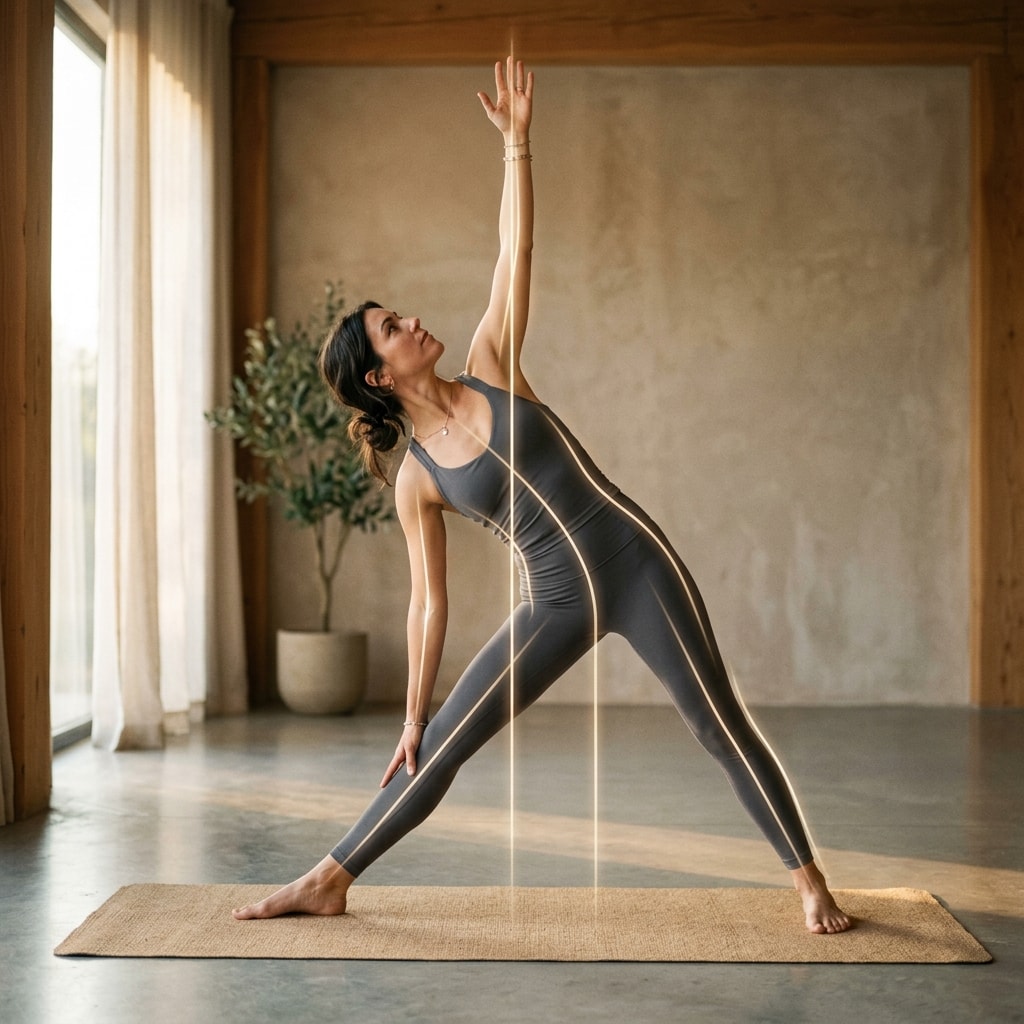
Structural Integration brings the know how to make the time spent in a pose a more effective and efficient place for the therapist or Yoga teacher to facilitate a positive change in the search for space and length at deeper fascial layers, whether it be through hands on manipulation or intelligent cuing. For example, in a pose like Trikonasana (Triangle pose), the therapist or teacher may cue the person to press down the center of the heel and extend through the deep lower belly to connect and integrate the length of a limb with the desired length at the front of the spine.
A Straighter Alignment
A third benefit that SI offers to Yoga is to redefine what constitutes straight in the body. Ida Rolf gave very precise direction regarding this element of structural order and her understanding of alignment has much to offer yoga. It is very challenging to independently de-rotate your own bony structure, untwist your fascial planes or reestablish equipoise with the muscle compartments when these structures are not in straight alignment and balanced relationship with each other to begin with. Typically a Yoga practitioner might stretch further into the twisted, rotated pattern that already exists. I can use the SI techniques to de-rotate bones, better organize muscles into proper compartments or untwist fascia layers to create a straight line through a limb facilitating a better alignment, a longer fascial stretch and improved balance through the Yoga pose. This straighter alignment is immediately recognized by the yogi, enhancing their learning process and their body and energy awareness.
The alignment searched for in SI can be many times different than that used most traditionally in certain poses. This difference in alignment is related to a more functional sense of anatomy that responds to a search for vertical line that manifests regardless of the position of the body in space. For example, in a pose like Tadasana (Mountain pose) the student is traditionally invited to open the chest up and draw the shoulders back and down, while SI would invite for the chest and shoulders to be relaxed and for the arms to drape down the sides effortlessly. In the search for a longer body SI challenges the traditional so-called normal curves of the spine towards a more vertical alignment.
Opening the Core
When the Yoga practitioner finds this straighter relationship in their pose, they are connecting through their own core, yet another advantage of SI. Ida Rolf defined the inside of the body as the "core" or intrinsic musculature and the outside as the "sleeve" or extrinsic musculature. This simple analogy represents a relationship of space between the deep and the surface. It is through fascial layering that SI uncovers and evokes the core space to open. This expanded sense of self spans through the body facilitating and enhancing the feeling of the breath and energy flowing through the core. It is important to understand this core space is an opening within the deep parts of the body, not a contraction of any musculature. Movement from the core represents the most fluid, graceful way to move with the least amount of physical effort. Any movement that causes the body to shorten or contract would in effect close down the core space. Most people inadvertently shorten as they move, overusing their sleeve/extrinsic musculature.
Many people practicing Yoga may also be overusing their sleeve. With my SI intervention we can readily recognize imbalanced core/sleeve movements and open up the core space during the Yoga pose. We can then guide the yogi to move and stretch through the core, ensuring that the lengthening occurs through the deepest part of the body, with the least amount of effort. There is a distinct energetic difference in discovering this new movement, amplifying the feeling of vitality that Yoga engenders.
In this way, we see how SI assists not just in finding a deeper place to connect with while in a pose, but, unlike traditional Yoga, SI also teaches us how to move from our deeper intrinsic core, related to the space within the bone, rather than a particular set of muscles such as the psoas. For example, as we walk or even as we move through a Surya Namascar (Sun Salutation flow), SI invites us to imagine our legs stem of the middle belly spine (T12-L1 area), rather than from the traditional understanding that the leg starts at the insertion of the femur bone into the hip socket. Thus, we make more connected and integrated movements, understanding that our core is not necessarily a muscle but maybe a center space within a bone that we elongate and move from. The deeper the core connection, the deeper the experience, which is ultimately a goal of Yoga.
Improved Grounding
It should also be understood that in any standing yoga pose, the grounding energy we feel flows through the core of our body and relates through gravity to the core of the earth. When the core space is closed we tend to pull up and out of our feet through our musculature, creating tension. We need a firm, solid foundation into the ground enabling us to be long in our upward stance. SI seeks an alignment and opening of the structure where there is no tension or holding anywhere in the body, which can only truly occur when the force of gravity flows through our core unimpeded. I want to teach each Yoga student to be able to identify tension patterns in their core while practicing. In addition to hands-on techniques that open the core space, I share verbal educational suggestions or imagery about how to let go through the core. The increased physical and energetic feeling of connection to the ground assists the yogi in every standing pose.
In this sense, we refer to not just the physical experience of the Yogi, but also a more subtle sense of relating to the reality around us. For example, as we stand in Virabhadrasana II (Warrior 2 pose), becomes firstly a better place for the therapist to help undo certain patterns of tension that may manifest in such position, but also SI invites the Yogi to ground through our newly found core to reestablish a deeper sense of proprioceptive and special awareness with a notion of upward extension as we press down the center of the heel.
A New Template of Alignment
Ida Rolf's primary premise of structural order is that of a vertical line passing in front of the spine, continuous through the top of the head and the bottoms of the feet. This line represents a relationship with gravity, the point around which everything falls. As a point of balance it is the goal of SI to organize the human structure through the fascial layers around that central axis of intention. We regularly stand our clients up during SI sessions to assess how their line is evolving. The practice of yoga can incorporate this vision into the stance of each yoga student, creating a new template of alignment. Each Yoga student can be evaluated standing to determine which "tailor-made" poses would help organize their structure around the "Rolf Line." This intentional, purposeful construct would evolve the fundamental practice of yoga.
Let's remind ourselves that the mere concept of alignment has been steadily evolving since its inception, and let's not forget either that Yoga is more than 5,000 years old. At the time Yoga was created the importance placed in a particular alignment was more energetic mental and spiritual. Over time and perhaps as a change in global consciousness, we realized the immense contribution of a more refined and efficient sense of physical alignment, as traditions like Iyengar sprout with similar intentions. As this relationship of the body and its parts with relation to space and gravity continues to evolve, we find ourselves developing new methods and techniques that express a new paradigm of standing, moving, connecting, sensing, feeling and experiencing reality. For example, as we find a more refined sense of alignment with the heels directly underneath the sitting bones and the arches of the spine not so pronounced, and where we extend over a new line from a deeper core that enable us to make.
Ida Rolf was adamant that this line of intention must pass through soft tissue, not the lumbar vertebrae. To this end, I would educate students for their legs to be directly underneath the pelvis with the lumbar vertebrae back in line with the thoracic spine. Too often in Yoga postures the lumbar vertebrae are quite far anterior, interfering with the line's relationship in the body. According to Rolf, most back problems stem from anterior lumbar vertebrae acting as a column of weight bearing support where eventually the compressed discs wear out or slip out of place.
Perhaps this new relational perspective could reduce injuries from Yoga practice as things "fall more into place". For example, we will provide a new 'place', where we don't have try so hard, which is a common cause of injury, and we can more practically relate the idea that 'less is more'.
In addition to the reduction of injuries, we see the marriage of SI and Yoga as a big aid in all physical rehabilitation processes. The essence behind most injuries is disconnection with that part of ourselves that has been injured. The methods of SI and the techniques of Yoga together provide a newer and better way of reestablishing the connection and integration within the body and with the mind and the spirit.
We finish SI sessions with our client standing, feeling their line with a new sense of lightness in the body. Clients quickly recognize that their effortless, upright structure is entirely supported by gravity. This heightened sense of structural balance gives a new appreciation in understanding what it means to be relaxed, content and at peace within one's body. This can potentially have a significant impact of one's own body image and the way we relate to ourselves and others. Our identification shifts from our physical self to the more intrinsic and subtle aspect of relating to our line and the energetic balance we have established with gravity through our core.
Experience the Integration of Yoga & SI
The Institute for Structural Integration continues to explore the profound intersection of disciplines. Contact John Latz to learn more.
Inquire About Training